
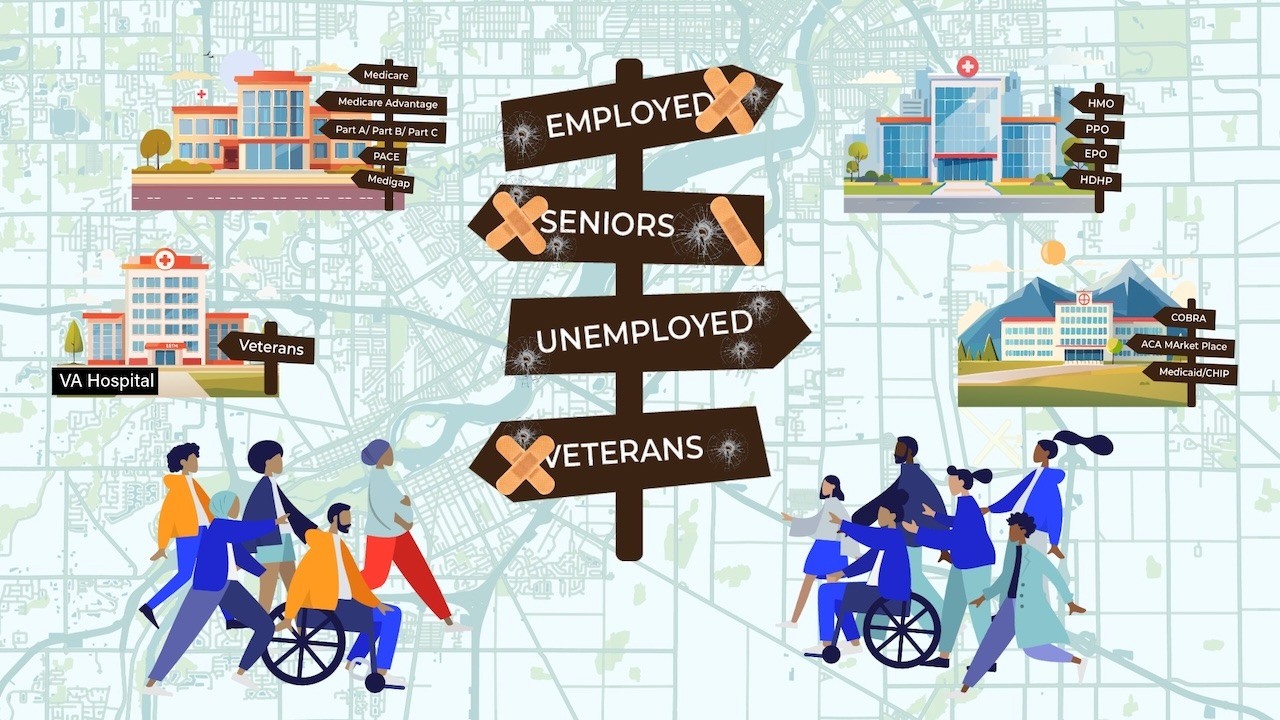
The Affordable Care Act (ACA), informally known as Obamacare, was signed into law in 2010, with major provisions taking effect in 2014. The law intended to constrain healthcare costs, improve quality of care, and reduce the number of uninsured individuals.
A decade after the ACA took effect, top health insurers have seen their revenues surge from approximately $500 billion in 2014 to more than $1.5 trillion in 2024, amassing over $375 billion in profits during this period. Despite these gains, healthcare remains largely unaffordable, placing a significant strain on employer finances. Furthermore, health outcomes are declining, the number of uninsured individuals under 65 is on the rise, and public confidence in the system has reached a historic low.
The US spends 18% of GDP on healthcare, about twice that of other developed nations. Over 65 years after the establishment of the Centers for Medicare and Medicaid Services (CMS), various attempts have been made to constrain costs. Costs have continued to rise. We look at reasons, core issues, and how to address these issues. We show that by right-aligning market forces from illness-care to wellness-care, the US can provide universal, sustainable, and affordable healthcare within CMS’s annual budget and achieve over $3 trillion in savings.
Flogging a Dead Horse
The figure below shows the various payment models that have been experimented with, in an attempt to control healthcare costs and cut wasteful spending. The costs have not just gone up year over year, but the rate of growth has increased over time.
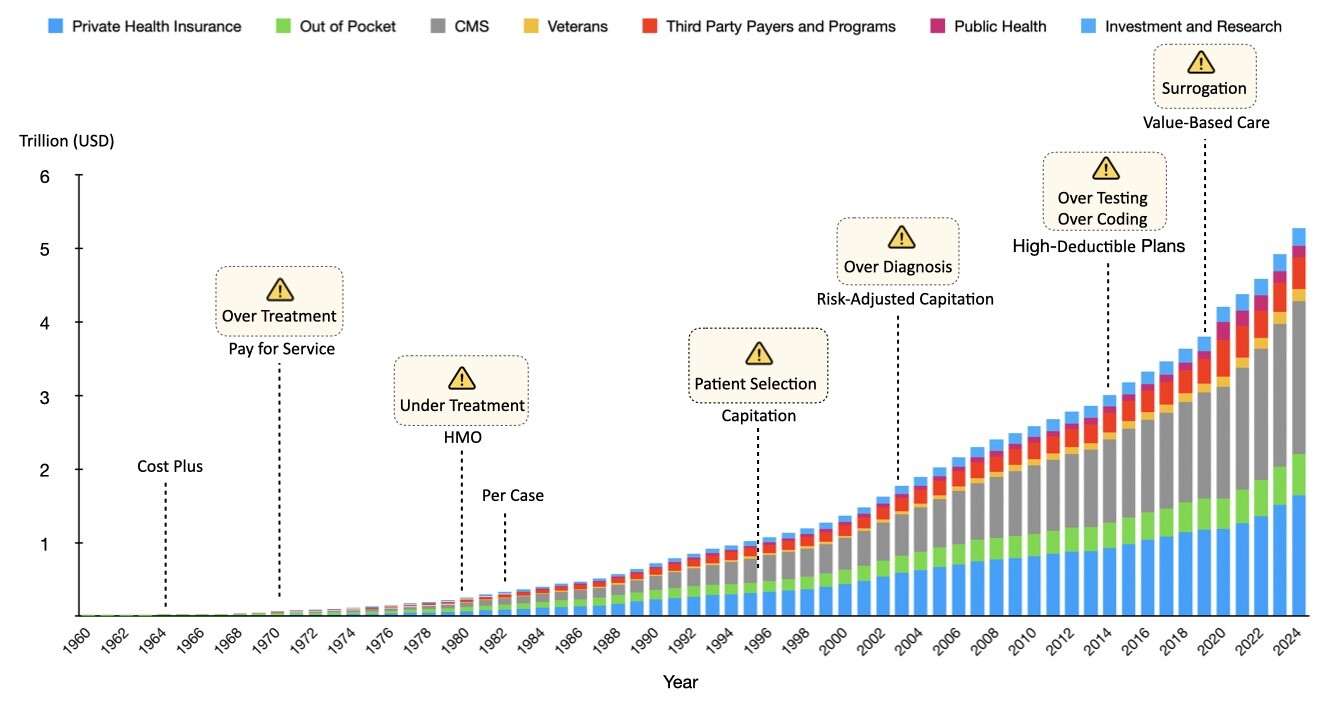
CMS payment models (Data- CMS, Visualization- Hawkai Data)
The Pay-for-Service model encouraged over-treatment; the HMO model encouraged under-treatment; the Flat-Rate Capitation Payment model encouraged patient-selection; the Risk-Adjusted Capitation Payment model encouraged over-diagnosis; Medicare Advantage and High-Deductible plans encouraged over-diagnosis; the Value-Based care model encouraged surrogacy, with dressed-up vanity metrics that would put a Kabuki artist to shame. Direct Primary Care is creating a two-tier concierge model of healthcare, allowing the wealthy to skip the queues and significantly increasing the cost of healthcare.
A patient is left with year-to-year increases in premiums and out-of-pocket costs, and year-to-year declines in community health outcomes. A free market utilizing the profit motive and transparent price signals is the ideal engine for achieving market efficiency. Why are health outcomes not consistent with market efficiency?
The Industry of Illness and Insecurity
A free market forces companies to innovate, improve efficiencies, and deliver products and services that customers need. This leads to improved margins and profits for the provider, and an improved experience and better outcomes for the customer.
Health care has clearly not delivered better outcomes for the customer. Is this a failure of the free markets? To answer this question, we have to recognize the product being sold in the healthcare marketplace. The commodity sold in the healthcare market is illness. The challenge for providers is to maximize revenue per patient, while the challenge for the payer is to minimize payouts per patient. In this battle for the dollar between the provider and the payer, the only casualty is the patient. The patient pays with higher premiums and higher out-of-pocket costs.
Curing a patient is not a sustainable business model, whereas chronic treatments generate recurring revenue. Healthcare market forces are directed toward illness-care rather than wellness-care, with incentives aligned in keeping patients sick, so they remain returning customers. Treating a symptom is profitable; addressing the root cause is a lost customer.
Similar to the healthcare market, which has commoditized illness, the cosmetic surgery market commoditizes insecurity. Both markets have been shown to be highly effective: the more illness, the more insecurity, the higher the demand, revenue, and profits. Markets are operating as designed, efficiently, and effectively marketing sickness and insecurity. Cosmetic surgery is not covered by insurance and is an out-of-pocket expense. The figure below shows the rise in healthcare costs for various payer models.
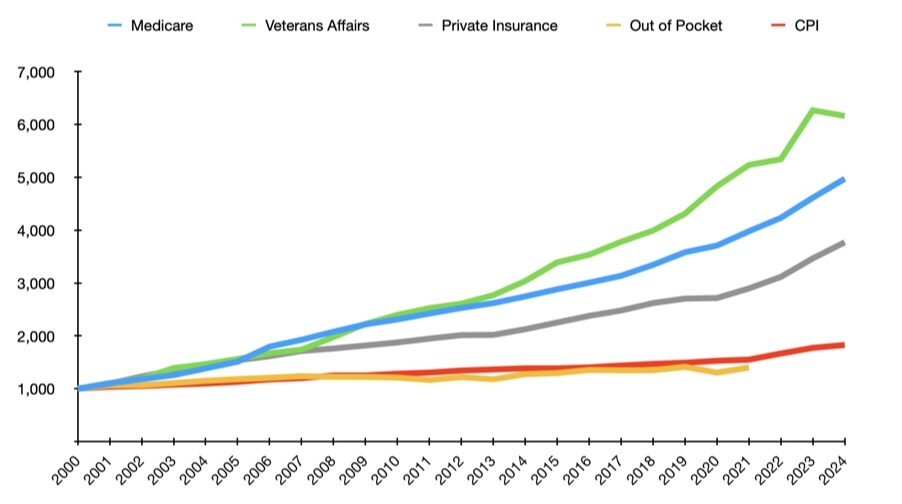
Normalized costs for different payers and inflation (Data- CMS, Aesthetic Institute, BLS Visualization- Hawkai Data)
Cosmetic surgery involves all the ingredients of regular surgeries, but the rise in prices for cosmetic surgery procedures is actually below the consumer price index. The Out-of-Pocket (Cosmetic surgery) model shows that when there is price transparency and no third-party intermediating payments, medical services can be provided at significantly lower costs [1].
In free market economics, supply and demand reach equilibrium at market prices. The problem is not the free market, but the misalignment of the market. If the healthcare market were aligned towards wellness-care, it must follow that better community health outcomes would lead to higher revenue and profits. The industry of insecurity and illness medicalizes normal conditions, turning ordinary ailments into medical problems, normal biological variations, like aging, or mood and hormonal changes, into serious pathologies, turning a person into a chronic patient, and a lifetime captive of the system.
The Prisoner’s Dilemma
John von Neumann is credited with popularizing modern game theory. The prisoner’s dilemma is a foundational game-theory thought experiment, in which two or more persons may betray the common good for individual gain. While cooperation provides the best outcome for both, fear of betrayal often leads to defection, resulting in a worse outcome for both. John Von Neumann proved that for any finite, two-player, zero-sum game, there is a strategy to minimize their maximum possible loss. Von Neumann’s minimax (minimize maximum loss) theorem is considered the beginning of game theory.
For many employees and seniors, open enrollment is a nightmare that they could do without. Open enrollment involves playing a version of the prisoner’s dilemma, a non-zero-sum game with asymmetric information, with the house holding all the cards. What most don’t realize is that when selecting a plan, they are subconsciously executing the minimax algorithm.
The information below is from Covered California and shows costs for a few family health insurance plans. These are the list prices; agents and brokers provide significant discounts and rebates on these plans. The data is just to illustrate the mechanism of the minimax algorithm.
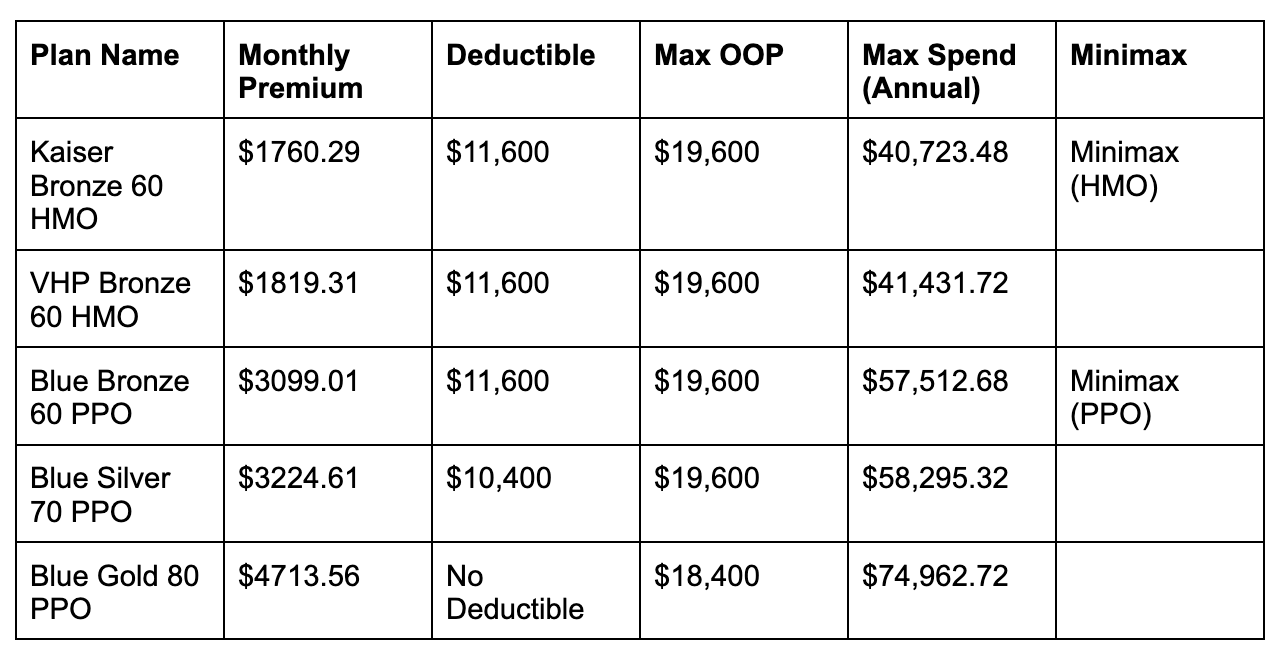
Covered California Healthcare Plans and the minimax algorithm
Many make poor choices with consequences that echo through the year, collectively selecting a sub-optimal outcome. The optimal strategy is not among the listed options. The optimal strategy, given the cost functions, is not to buy insurance.
Under the Affordable Care Act, the individual mandate required everyone to have health insurance or pay a penalty. While the federal requirement to maintain essential coverage remains legally in the books, Congress passed the Tax Cuts and Jobs Act in December 2017, which reduced the associated tax penalty to zero. Although the federal government no longer assesses a penalty, several states, including California, have enacted state-level mandates and enforce their own tax penalties for uninsured residents. Form 1095-A/B/C is still required to prove qualifying health coverage to the IRS. Without coverage, the penalty in California is $950 per adult and $475 per dependent, or 2.5% of annual income, whichever is higher.
Self-pay rates for medical services are significantly lower than health insurance company negotiated rates. Insurance companies pay over $2000 for an MRI. The same MRI is available for self-pay patients at an outpatient imaging center for $400. Routine surgeries like cataract are available for less than the out-of-pocket share of costs through medical tourism in India. A heart bypass surgery through medical tourism in India costs less than the yearly deductible [2].
A California family of four that opts out of insurance, at a minimum, pays $2850 as a penalty towards healthcare. The average cost of healthcare in the US in 2024 was $14,570 per person annually, totaling $58,280 for a family of four. It would take a couple in their late twenties about 35 years before they became eligible for Medicare, and they would have spent over $2 million towards health insurance. With self-pay, if the savings were invested, the family would have over $2 million in their bank account by the time they become eligible for Medicare.
While cooperation (everyone agrees not to buy insurance) provides the best outcome for all, the fear of betrayal drives defection, toward buying an insurance plan that minimizes the potential maximum cost. While a patient defects and ends with a sub-optimal outcome, what stops employers from defecting? Is cooperation in their best interests? Why can’t employers deal directly with the providers, without insurance in the middle? To answer, we need to generalize the 2-person game into an n-person game.
The Nash Equilibrium
2300 years before John von Neumann, Vishnugupta (Chanakya) not only outlined the basic principles of game theory in his book Arthashastra [3]; he also put it into practice, enabling Chandragupta Maurya to establish the Maurya Empire (322 – 185 BC) and consolidate the entire Indian subcontinent. Chanakya described the Mandala, a state of equilibrium between states, where no state had an incentive to alter the status quo, as any action would result in a suboptimal outcome. Chanakya maintained the equilibrium using a network of spies by ensuring that the cost of defection (betrayal) was extremely high and the assurance of cooperation (loyalty) was high through surveillance, probably the earliest recorded application of the prisoner’s dilemma.
In 1950, John Nash, in his doctoral dissertation on game theory, formalized this notion of equilibrium for n-person games. Now called the Nash equilibrium, the Mandala is a state in which participants don’t change strategies, because any change would result in a sub-optimal outcome. Systems in Nash Equilibrium are self-regulating, as they represent a stable state where no individual participant has an incentive to deviate unilaterally from their chosen strategy. Once this point is reached, the system naturally maintains itself without external regulation, as any change in a single player’s behavior would result in a worse outcome for them. Nash proved that every finite n-player, non-zero-sum, non-cooperative game has a Nash equilibrium.
The US healthcare system operates in a Nash equilibrium, where stakeholders (insurers, providers, physicians, Pharmacy Benefit Managers (PBMs), Pharmaceutical companies, employers) act in their own best interests, making unilateral change difficult. No player has an incentive to change their strategy alone. Employer-based insurance usually pays 3x – 5x for a procedure when compared to Medicare rates. To reduce healthcare costs, Employer-Direct is often discussed as an option, where employers negotiate directly with the provider, eliminating the insurer.
For many employers, healthcare costs are a significant and growing financial burden. Chronic illnesses, expensive speciality drugs, and inflation are forcing businesses to actively balance competitive benefits against maintaining their bottom line. Starbucks spends more on healthcare than it does on coffee beans. Ford and GM spend more on healthcare for their employees and retirees than on the steel used to build their vehicles. For many municipalities, adding GLP-1 weight loss drugs to their health insurance plans is bankrupting towns, forcing them to choose among cutting critical city services, limiting coverage, long-term debt, or layoffs. Similarly, the high cost of healthcare benefits is forcing companies toward automation, AI, or offshoring to reduce headcount. City cuts affect critical services and delays needed infrastructure upgrades. Companies can continue delivering services and grow by leveraging technology and offshoring. Employers have many better options to cut costs than Employer-Direct health plans.
Companies seeking to reduce healthcare costs would rather slash headcount or hire contractors rather than try to negotiate better deals directly with a provider. Companies would rather focus on their core business than on managing claims, billing audits, and pre-authorizing treatments. Instead of the company subsidizing healthcare, the laid-off employees get subsidized by the state, with no impact on revenue to the insurer or the provider. A system in Nash Equilibrium has no incentive for change.
Regulations will not alter the Nash Equilibrium; it just adjusts cost functions. Reforming healthcare requires right-aligning market forces from illness-care to wellness-care. When incentives align with wellness-care, better health outcomes will result in higher profits. Right-aligning market forces will require de-retailing insurance, de-linking insurance from employment, and de-fragmenting healthcare data.
De-Retail, De-Link, De-Fragment
The Direct-Care Capitation Payment model [4] of healthcare right-aligns market forces from illness-care to wellness-care. It does this by de-retailing insurance, from being the gatekeepers of community health to providing financial security for secondary and tertiary care. It is the primary care provider that assumes the risk for secondary care. The primary care provider becomes the only touchpoint for a patient. The Direct-Care Capitation Payment model de-links insurance from employment, with the public choosing a primary care provider instead of an insurance plan, with monthly premiums paid directly to the primary care provider..
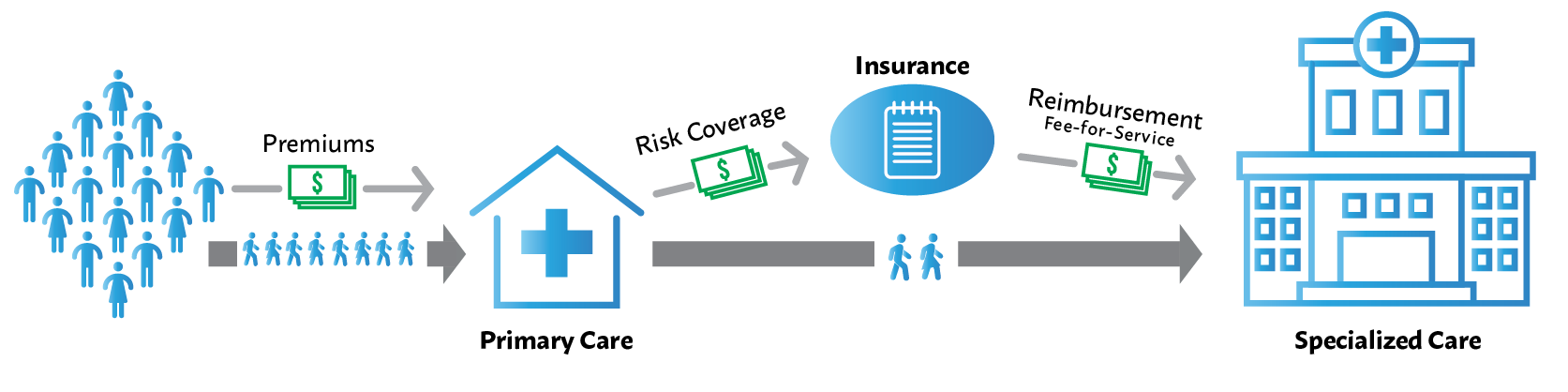
Direct-Care Capitation Payment Model
The goal of a free market is to foster fair and open competition, and avoid monopolies. Monopolies stifle competition, innovation, and consumer choice, while driving up prices. Epic Systems is the market leader in Electronic Health Records (EHR). Epic Systems maintains longitudinal health records for over 325 million individuals worldwide and dominates the EHR market with over 40% market share. The US EHR market is highly fragmented, with hundreds of vendors offering EHR products, and a few like Epic Systems and Oracle Health (formerly Cerner) controlling large segments of the market.
One of the reasons for the high costs of healthcare is fragmented data and incompatible IT systems across providers and payers. The lack of an integrated digital infrastructure where patient records can be accessed seamlessly across providers and payers delays treatments, inflates costs, and leads to medical misdiagnosis, repeat testing, inappropriate medications, and polypharmacy.
EHR, when viewed as public goods, ensures that health data is treated as a shared societal digital infrastructure [5]. Data de-siloing will improve care coordination across diverse health networks, allow clinical data to be aggregated in real-time, and will vastly improve tracking and response times during large-scale health emergencies and pandemics.
Data exchanges are key to reducing healthcare costs and improving care coordination.
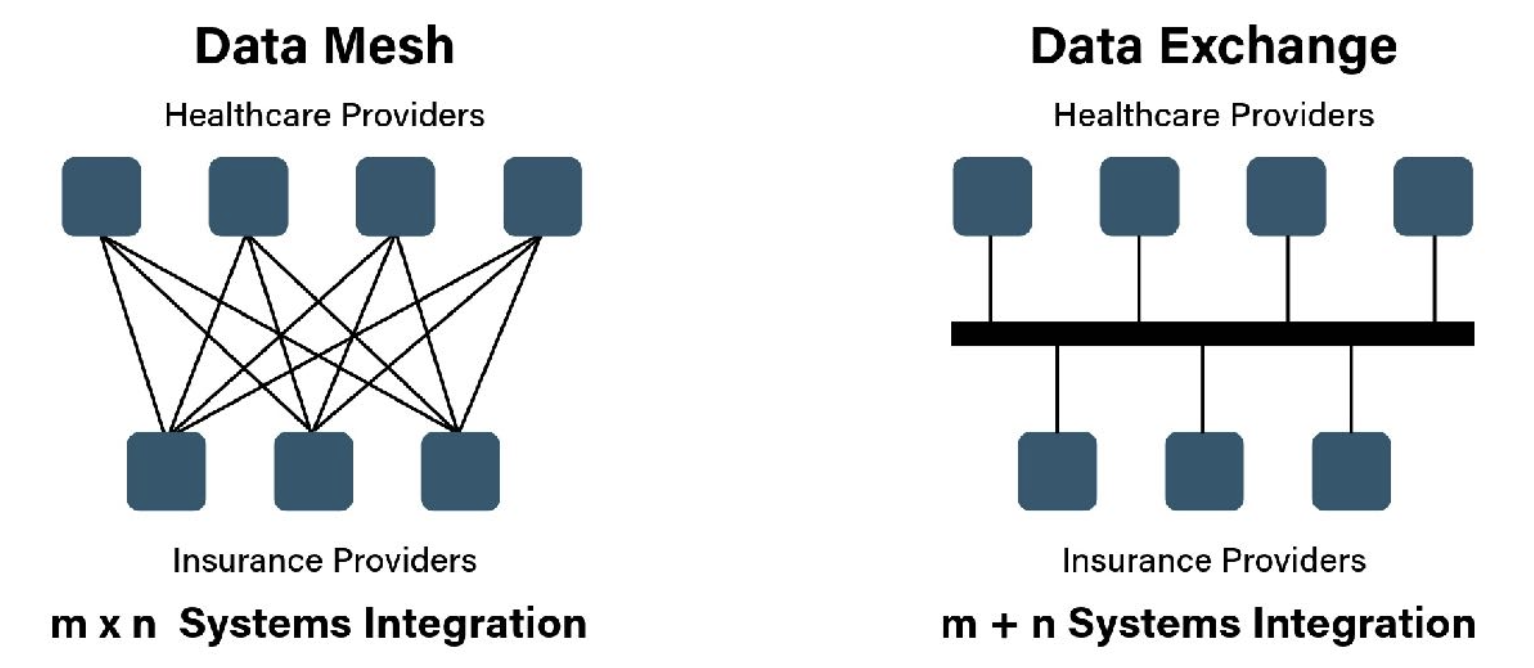
Data exchanges are key to reducing healthcare costs and improving care coordination.
Data exchanges and open APIs will allow for nation-level datasets to be de-identified and made available for shared research. The availability of these population-scale datasets will give data analytics, ML, and AI workloads the data volumes to avoid algorithmic bias, researchers the ability to replicate and verify results independently, companies the ability to accelerate the development of new drugs and treatments, and countries the ability to craft data-driven public health policies and localized healthcare interventions.
To determine the future of healthcare, we have to first understand how we got here. Knowing how we got here will provide the compass to navigate to where we want to go from here.
Moving Forward, Looking Backward
In the 19th century, the third cholera pandemic, from 1849 – 1860, resulted in the highest number of fatalities. In 1854, John Snow plotted deaths from cholera in the Soho District of London on a map. He used the map to trace the source of London’s cholera outbreak to a public water pump, establishing cholera as a waterborne disease. With a better understanding of the nature of cholera, Oral Rehydration therapy would become the gold standard of treatment. Dr. John Snow is considered the founding father of epidemiology and geospatial analytics.
Before Snow, it was thought that cholera was spread by miasma, a toxic vapor, and the medical community’s understanding of the illness was entirely empirical, and a variety of treatments were experimented with. Allopathy was based on humorism, where illness was considered an imbalance of body fluids, and treatments involved blood-letting, sweating, emetics, or purging. A Medical Council was established in England in 1854, and a major epidemiological survey was commissioned to find out which treatments were most effective. It was found that mortality rates at the London Homeopathic Hospital (18.4%) were significantly lower than in Allopathic hospitals (46.0%). Homeopathy was based on vitalism, which relied on supporting the body’s natural self-healing properties
In 1900, Dr. Thomas Lindsley Bradford published The Logic of Figures [6], a data-driven comparative analysis of treatment methods for various diseases, leveraging real-world evidence from hospital records to evaluate clinical effectiveness. In the case of cholera, his analysis showed that mortality rates were almost three times higher for patients on allopathic treatments than patients on homeopathic treatments (Allopathic treatment mortality rate: 49.57%, Homeopathic treatment mortality rate: 16.83%). Homeopathic treatments were also reported to be significantly cheaper than equivalent allopathic treatments.
In 1910, Abraham Flexner published a landmark report, Medical Education in the United States and Canada [7]. The Flexner Report, commissioned by the Carnegie Foundation and presented to the US Congress, would lay the groundwork for the modern medical system we see today. It would transform the nature and process of medical education in America.
The Flexner Report moved medicine from traditional, holistic healing practices towards a heavily scientific and organ-centric model. It moved focus from whole-body wellness to treating illness. The medical school curriculum was broken into the study of individual systems and organs rather than seeing a patient as a complete, interconnected whole.
Abraham Flexner was neither a physician nor a researcher. He advocated for science but had himself ignored or was unaware of Dr. Thomas Bradford’s comprehensive study and data on clinical effectiveness. Homeopathy, naturopathy, osteopathy, and alternative wellness disciplines were derided, marginalized, and characterized as unscientific. The Flexner report triggered the closures of minority and alternative medical schools. Symptomatic treatment would become evidence-based science and vitalist therapies became quackery.
Abraham Flexner would go on to found the Institute for Advanced Study in Princeton, whose faculty would include Albert Einstein, John Von Neumann, and John Nash. In 1939, Flexner wrote an essay in Harper’s Magazine titled The Usefulness of Useless Knowledge [8]. In it, he calls for support for basic research, enabling unfettered inquiry, and fostering curiosity, freedom, and imagination. He argues that what was considered useless knowledge historically could potentially have extraordinary utility in the future.
The American Medical Association (AMA), by then, had gravitated toward the highly utilitarian, standardized, and problem-solving medical model that Flexner had advocated in his 1910 report. The AMA’s primary focus remained anchored in raising medical education standards, ensuring the production of capable physicians. The AMA’s standardized training prioritized quantifiable metrics and created a “teaching to the test” culture, where consistency was valued over creativity, exploration and ambiguity discouraged, and non-conformance penalized. By 1925, the AMA had firmly established itself as a monopoly controlling the labor supply of physicians, governing over-production, and fulfilling its founding mission of enhancing the earning power of practicing physicians.
In 1945, President Harry S. Truman outlined a set of proposals, which would later be called the Fair Deal, aiming to secure civil rights, expand social-welfare programs, and maintain economic stability in the post World War 2. The goal of the Fair Deal was to build upon President Franklin D. Roosevelt’s New Deal and transition the United States from a wartime economy to a peacetime economy. The Fair Deal established the call for universal health insurance. The Wagner-Murray-Dingell Bill contained the legislative provisions to enact Truman’s national health program into law and was introduced multiple times but never advanced beyond the committee hearing stage. The principal lobby against the bill was the AMA.
The AMA enlisted Campaigns Inc., America’s first political-advertising firm, to turn public opinion against universal healthcare. Campaigns Inc. branded universal healthcare as socialized medicine and launched a nationwide media war against the healthcare plan. The AMA spent $5 million on the campaign over a three-year period. Its effects would last decades. It turned Truman’s sensible and needed reform into a bogeyman that still scares people today. It gave the AMA complete control over medical education and the delivery of healthcare. The irony was that the only thing socialized, that was not a free market balancing supply and demand, was the supply of physicians.
Band-Aids don’t fix Bullet Holes
The AMA advocates for physicians and medical students. Pharmaceutical companies, healthcare providers, PBMs, and health insurance companies have their lobbyists. Hospital staff have their unions. Everybody has a voice. Who speaks for the patient?
The Mauryan dynasty lasted 137 years. It was not a disturbance in its external equilibrium that led to its collapse. It crumbled from within. It is over 115 years since Abraham Flexner’s report that laid the foundations of the modern American healthcare system and cemented physician authority. High healthcare costs are forcing businesses to automate or offshore and reduce headcount, with employer subsidies picked up by the state. Adding GLP-1 weight loss drugs to insurance plans is bankrupting municipalities. The expanded subsidy rules that expired on December 31, 2025, doubled and even tripled healthcare premiums. It is forcing many to drop insurance. Flexner’s legacy and AMA’s oversight and orchestration that ensured stakeholder equilibrium for over a century is now fracturing from within. Fissures run too deep. It too will collapse. Band-aids don’t fix bullet holes.
Markets are amoral and will always put profits over morals or ethics. Today, it incentivizes sickness. The Direct-Care Capitation Payment model right-aligns the market towards wellness-care. It will incentivize early interventions, prioritize prevention over treatment, palliation over procedure, wellness over illness, and quality of life over quantity of life.
The Direct-Care Capitation Payment model will balance the mix of generalists and specialists, and incentivize providers to refocus on primary care and community health. It will give communities a voice. Right-aligning the market from illness-care to wellness-care, will save over $3 trillion and enable CMS to provide universal, sustainable, and affordable healthcare. It will create resilient communities, make businesses more competitive, and increase social capital. It will align profits with quality of care and health outcomes, and secure for all their unalienable right to the pursuit of happiness.
References
[1] John, Ranjit. Transforming Healthcare – Better outcomes at Lower Costs. Available at https://www.linkedin.com/pulse/transforming-healthcare-better-outcomes-lower-costs-ranjit-john
[2] John, Ranjit. The Missing Middle – Towards Universal and Affordable Healthcare. Available at https://www.linkedin.com/pulse/missing-middle-towards-universal-affordable-health-coverage-john
[3] Shama Sastri. Kautilya’s Arthashastra (English Translation). Available at https://archive.org/details/kautilyasarthasastraenglishtranslationshamasastrir.1929
[4] John, Raina. The Rash that cost $1538. Available at https://www.linkedin.com/pulse/rash-cost-1538-ranjit-john
[5] John, Ranjit. Delay, Deny, Deduct. Available at https://www.linkedin.com/pulse/delay-deny-deduct-ranjit-john-0upxc
[6] Bradford, Thomas Lindsley. The Logic of Figures Or Comparative Results Of Homeopathic And Other Treatments. Available at https://archive.org/details/logicoffiguresor00brad/page/38/mode/2up
[7] Flexner, Abraham. Medical Education in the United States and Canada. Available at https://archive.carnegiefoundation.org/publications/pdfs/elibrary/Carnegie_Flexner_Report.pdf
[8] Flexner, Abraham. The Usefulness of Useless Knowledge. Available at https://www.ias.edu/sites/default/files/library/UsefulnessHarpers.pdf
Data Sources
Centers for Medicare and Medicaid Services (CMS) data is available at https://data.cms.gov/
U.S. Bureau of Labor Statistics (BLS) data is available at https://www.bls.gov/data/
The Aesthetic Society data is available at https://www.theaestheticsociety.org/media/procedural-statistics
Credits
Graph image uses Warning icons created by Andrean Prabowo – Flaticon
Header image uses illustrations by Pablo Stanley Courtesy of Humaaans licensed under CC0