On November 7, 2025, a two-judge bench of the Supreme Court reassured Pushkaraj Sabharwal, the 91-year old father of Captain Sumeet Sabharwal, the pilot in command of AI 171 that crashed in Ahmedabad on June 12, 2025, that no one in India believes that the accident was the pilot’s fault.
Frustrated by a lack of transparency from AAIB India, Pushkaraj Sabharwal approached the Supreme Court contending that the preliminary report into the crash was profoundly flawed, as the probe team was predominantly focused on the pilots who could no longer defend themselves.
The Supreme Court’s statement brought little comfort to Pushkaraj Sabharwal, as media immediately challenged the court’s statement saying that such statements may provide a balm to the father but we have to face the truth. If the pilot did not move the fuel control switch, then who did?
Pilots being interviewed on Indian TV networks point to the possibility of an electrical short caused by water ingress into the electronic/equipment (E/E) bay as the reason for the fuel cutoff and engine shutdown. This is an emotional response and pure speculation. Nothing in the data provided by the AAIB points to this, but that has not stopped social media aviation ‘experts’ from advocating the water ingress theory.
To determine what truly happened, we must set aside emotions, disregard ‘independent’ media reports from major newspapers, and ignore the speculation of aviation ‘experts’ on YouTube. The sole reliable information accessible to the public is the AAIB’s preliminary report. In fact, this preliminary data alone is sufficient to conclusively prove that Captain Sabharwal did not move the fuel control switch. Instead, he behaved professionally, making every effort to stabilize the aircraft and recover from a catastrophic failure. Unfortunately, he lacked the necessary altitude for a successful recovery.
Courts follow precedent, where past court decisions are used as authority for deciding similar current cases. Similarly, aircraft accident investigators look at priors to get a sense of what might have led to the accident.
AI 171 is the first instance of a Boeing 787 Dreamliner suffering a catastrophic dual engine failure. Dual engine failures have happened before on other models of aircraft. Have there been prior cases where a similar dual engine shutoff has happened? Are there lessons that we can learn and get to the truth?
Did the Pilot move the Switch?
On January 15, 2009, about 100 seconds after takeoff, US Airways Flight 1549’s engines were hit by a flock of Canada geese. The repeated thumps of the geese smashing into the engines were followed by the eerie silence of both engines shutting down. Neither Captain Chesley “Sully” Sullenberger nor First Officer Jeffrey Skiles had initiated the shutdown.
Flight 1549 was an Airbus A320. The NTSB Aircraft Accident Final Report for Flight 1549 [1], adopted May 4, 2010, is publicly available and provides insightful details on pilot action when faced with a dual engine shutdown.
Page 55 of the report has footnote 95, which is key to understanding the AAIB’s preliminary report on AI 171. This is in the context of the pilots’ attempt to relight the engine. From page 55,
FDR data indicated that both thrust levers were set to the idle position at 1528:01, about 50 seconds after the bird encounter. The N1 and N2 speeds for the left engine both decreased while the speeds for the right engine did not respond. About 30 seconds later, the right engine master switch was moved to the OFF position.⁹⁵
⁹⁵ The engine master switch position is not recorded by the FDR; however, the engine master switch position was derived indirectly by noting the position of the high-pressure fuel valve.
Footnote 95 from the NTSB report clearly states that the FDR (Flight Data Recorder) does not record the switch position. The switch position is inferred by the position of the fuel valve. In other words, the data recorded in the FDR is the digital state (on/off) of the fuel valve and not the position of the fuel control switch.
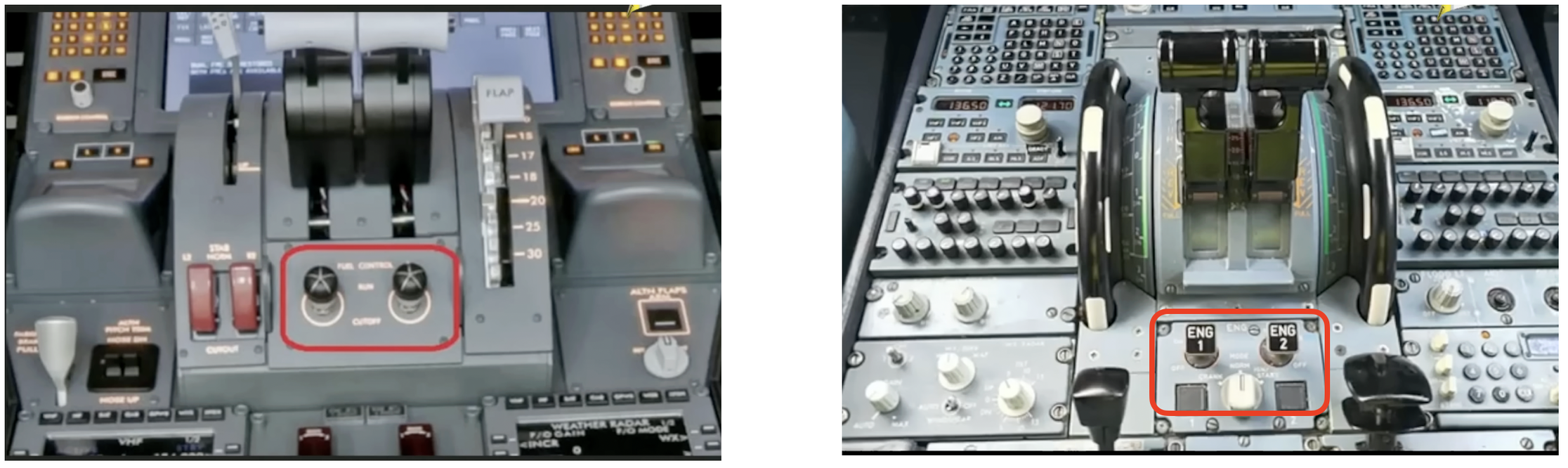
The engine master switch on an Airbus A320 has the same functionality as the fuel control switch on a Boeing 787. The Airbus engine master switch has positions marked as ON and OFF, whereas the Boeing fuel control switch has positions marked as RUN and CUTOFF.
As the NTSB report states, what is recorded is the digital state of the fuel valve and not the switch position. When the geese hit the engines, the FADEC initiated an engine shutdown, and the fuel valve closed. While the digital state of the fuel valve changed to OFF, the engine master switch remained in the ON position.
On January 15, 2009, Captain Chesley Sullenberger did not move the engine master switch to shut down the engine. On June 12, 2025, neither did Captain Sumeet Sabharwal. It was the logic in the Full Authority Digital Engine Control (FADEC) that triggered the fuel valve shutoff and engine shutdown. The fuel control switch did not move and remained in the RUN position.
For Flight 1549, the engine shutdown was initiated by the FADEC system after geese struck the engines. There are sensors around the engine that monitor various aspects of engine performance. The FADEC logic is designed to trigger a shutdown when sensor data suggests the possibility of the engine’s integrity being compromised.
The AAIB preliminary report for AI 171 clearly ruled out a bird strike. We will only briefly discuss the cause of the FADEC-initiated fuel shutoff, as we have explained in detail in our previous articles [2, 3, 4]. First, it is essential to understand what happens in the cockpit during an emergency.
Pan-Pan and Mayday
The fundamental principle guiding pilots in emergency situations is Aviate, Navigate, and Communicate (ANC). After ensuring the aircraft’s stability, they consult an emergency checklist. This process begins with immediate, memorized actions, followed by the structured steps of the checklist for the specific emergency. The checklist acts as a crucial safety net, mitigating human errors that can arise from fatigue, stress, or distractions among the crew.
The Canada geese hit the engines of Flight 1549 between 15:27:11 and 15:27:12. By 15:27:13, the FADEC had initiated an engine shutdown. At around 15:27:21, Captain Sullenberger started the APU (Auxiliary Power Unit), and at 15:27:23, he took over control of the airplane, stating, “my aircraft.” At 15:27:28, the captain instructed the first officer to “get the QRH [Quick Reference Handbook] loss of thrust on both engines.”
Airbus designed the Engine Dual Failure checklist to address the occurrence of a dual engine failure above 20,000 feet, as the probability of a dual engine failure was much greater at higher altitudes. Airbus did not have a dual engine failure checklist for use at low altitudes. The checklist is three parts,
Part 1 – differentiate between a no fuel remaining and a fuel remaining condition and included steps to attempt an engine restart
Part 2 – contained guidance to follow if an engine restart was successful or if an engine restart was not possible
Part 3 – contained guidance for the flight crew to follow if a forced landing or a ditching was anticipated
Part 1 consists of 15 steps from (a) to (o). Step (e) is to deploy the RAT and step (k) is to start the APU. Captain Sullenberger had started the APU before consulting the QRH, so they could skip (e) and attempt an engine restart using APU bleed. The airplane’s low altitude and airspeed did not allow for a windmilling restart of the engines.
There is another lesson from the NTSB report that needs to be internalized by airline accident investigators (especially those investigating the Jeju Air crash from December 29, 2024). Multiple attempts were made to relight the engines, but all attempts failed despite the APU being switched on. Once a FADEC has marked an engine as ‘compromised’, it will ignore the relight command.
The Boeing 787 Dreamliner automates many of these functions and has a significantly smaller checklist for dual engine failure. On a catastrophic electrical failure, the RAT is deployed and the APU is started automatically. In the case of AI 171, the FADEC had not marked the engines as ‘compromised’, which allowed the possibility of relight and thrust recovery. Page 15 of the preliminary report states,
The EGT was observed to be rising for both engines indicating relight. Engine 1’s core deceleration stopped, reversed and started to progress to recovery. Engine 2 was able to relight but could not arrest core speed deceleration and re-introduced fuel repeatedly to increase core speed acceleration and recovery.
The recorded Exhaust Gas Temperature (EGT) was rising which indicated relight. Engine 1 started the process to recovery, but it was too late. They unfortunately did not have the altitude that they needed to recover.
On Flight 1549, Captain Sullenberger was aware that the loss of thrust was caused by the engines shutting down because of the bird strike. He had situational awareness. It took him 15 seconds to call for the “loss of thrust to both engines” handbook.
On AI 171, Captain Sabharwal was aware of the loss of thrust a few seconds after 08:08:42 UTC (the time when Engine 1 shut down. AAIB did not provide a timestamp for First Officer Kunder’s remark – why did he cutoff. We can assume that it was a few seconds after 08:08:42 UTC). Less than 10 seconds after becoming aware of the loss of thrust, Engine 1 relights.
The pilots were flying blind, without situational awareness, unaware of the algorithmic decision-making that had caused each engine’s FADEC to execute an uncommanded action, leading to the engine shutdown and subsequent relight [4].
Captain Sullenberger’s engines failed at 2818 feet (agl), while Captain Sabharwal’s engines failed at 452 feet (agl). The key factor leading to the different outcomes was altitude.
Laboratory for Alternative Theories
AAIB’s biggest failing has been its media management. If you don’t set the narrative, someone else will. The lack of transparency has led to social media serving as a laboratory for alternative theories. Two theories have gained traction and have many believers. One theory is a failure of the Weight-on-Wheels (WoW) sensor and the other is the Water Ingress theory.
On January 17, 2019, ANA flight NH-985, a Boeing 787, suffered a dual engine shutdown while landing at Osaka Itami Airport. The pilots had deployed thrust reversers after touchdown to slow down the aircraft and shortly thereafter noticed that the engines had shut down. The aircraft rolled down the runway and came to a stop, but the pilots were not able to restart the engines, and the plane had to be towed. The root cause was attributed to the TCMA (Thrust Control Malfunction Accommodation) system in the FADEC being activated as the reverse thrusters were deployed before the aircraft WoW sensors had transitioned to ground mode. Pilots were advised to delay deploying thrust reversers on landing.
This dual engine failure happened on landing. When landing in high winds, a plane may touch the ground but then get lifted up because of the winds. If the thrust reversers were deployed and then the aircraft was temporarily lifted off the ground, the WoW sensor would transition to air mode triggering the TCMA logic, resulting in the engines shutting down.
The dual engine failure on AI 171 occurred on take-off. Page 14 of the preliminary report has the line,
The aircraft air/ground sensors transitioned to air mode, consistent with liftoff at 08:08:39 UTC.
The preliminary report clearly says that the aircraft had transitioned from ground mode to air mode. There is no data in the AAIB preliminary report that suggests a Weight-on-Wheels (WoW) sensor failure. We can junk this theory.
In May 2025, the FAA adopted an Airworthiness Directive (AD 2025-09-12) [5] for certain Boeing Dreamliner models. The AD was prompted by reports of water leakage from the potable water system due to improperly installed waterline couplings, as well as water leaking into the electronics equipment (EE) bays from above the floor in the main cabin, resulting in water on equipment in the EE bays.
Although the unsafe condition has been known since 2016 (AD 2016-14-04), the omission of sealant in the airplanes added to this AD didn’t occur until 2018. The sealant is one of many layers intended to prevent water ingress into the aft EE bay. VT-ANB (AI 171) was delivered to Air India in January 2014, years before the 2018 flawed Boeing design documents (missing sealant) that necessitated AD 2025-09-12. AD 2025-09-12 specifically applies to only 47 US-registered airplanes (and does not apply to VT-ANB).
To suggest that the remedial fixes for AD 2016-14-04 were not carried out on VT-ANB is speculative. The 787 is a highly redundant aircraft, if one component fails, another will pick up its function. Even if water were to enter the EE bays and bypass the drip-shield protection for critical equipment, it is improbable that it could create electrical faults that would affect both engines simultaneously. There are no priors where water ingress has caused engine failure.
This hypothesis is seriously flawed and a possibility only in Bizarro world. Let’s be clear, the water ingress theory holds no water.
Silence often speaks the Loudest
The data in an accident report is pieced together from the Flight Data Recorder (FDR), Cockpit Voice Recorder (CVR), airport CCTV, user sourced videos, Airport Surveillance Radar (ASR), Air Traffic Control communications (ATC), and survivor statements. For data points where the time of an event is mentioned, clocks have to be synchronized between the FDR, CVR, ASR, ATC, and CCTV footage.
The CVR and FDR share a common reference time. CCTV cameras and the ASR have their own clocks and the time must be synchronized with the CVR and FDR time (Footnote 83 on page 47 of the NTSB report [1] says – The CVR, FDR, and EWR ASR data were synchronized to the EWR ASR time as a common reference time (EWR – Newark Liberty International Airport, ASR – Airport Surveillance Radio)).
Final reports of an accident provide the provenance of the data. AAIB’s preliminary report also does it but not consistently. In a LinkedIn post titled Read the words – not just the data [6], Capt. Amit Singh made a keen observation about the report. Every line where ‘as per EAFR’ is mentioned, there is precision in language and timestamps. When it is not used, language is not as precise and time gaps are used instead of timestamps. It is as if the data is inferred from CVR audio analysis or external sources.
EAFR is not mentioned between 08:08:39 UTC and 08:08:47 UTC. This is exactly in line with the argument that a catastrophic electrical failure occurred between the 39th and 40th seconds, which caused the RAT to extend outward. The electrical failure disables the network switches and the Remote Data Concentrators (RDCs) on the AFDX data bus between the FADECs, sensors, and the CCS [4]. This network failure would have prevented data from reaching the EAFR.
Once the RAT restored a secondary power channel and powered back the RDCs, data would start reaching the EAFR post 08:08:47 UTC. We explain this in detail in our article Ducks, Geese, and Planes [4].
Nothing but the Truth
Legal systems in many English-speaking countries use the phrase “the truth, the whole truth, and nothing but the truth” as an oath for witnesses in legal proceedings to ensure that they provide complete and accurate testimony.
The AAIB preliminary report states the truth, but not the whole truth, and also fails the ‘nothing but the truth’ pledge. We now list a set of questions that the Supreme Court can ask to get to the whole truth, and nothing but the truth.
1. Page 14 of the preliminary report has the following line,
The aircraft achieved the maximum recorded airspeed of 180 Knots IAS at about 08:08:42 UTC and immediately thereafter, the Engine 1 and Engine 2 fuel cutoff switches transitioned from RUN to CUTOFF position one after another with a time gap of 01 sec.
This paragraph does not have ‘as per EAFR’ and does not refer to the source of data. What is the source of the airspeed data and the fuel cutoff switch transitioning from RUN to CUTOFF?
Is the airspeed data from the Airport Surveillance Radar (ASR)? If so, were the clocks between the ASR, CVR, and FDR synchronized?
Is the Engine 1 and Engine 2 fuel cutoff time inferred from an audio analysis of the CVR? Do you hear the clicks of the fuel cutoff switches being moved in the CVR?
2. Page 15 of the preliminary Report has this line,
As per the EAFR, the Engine 1 fuel cutoff switch transitioned from CUTOFF to RUN at about 08:08:52 UTC. The APU Inlet Door began opening at about 08:08:54 UTC, consistent with the APU Auto Start logic. Thereafter at 08:08:56 UTC the Engine 2 fuel cutoff switch also transitions from CUTOFF to RUN.
The data source is attributed to EAFR. Does the EAFR record the fact that the fuel cutoff switch in the cockpit was physically moved or does it record the digital state of the fuel valve? If it records the digital state of the fuel valve (as mentioned in the NTSB report [1]), could this transition have been initiated by the FADEC (without the fuel cutoff switch being physically moved)?
Do you have any data to show that the fuel control switch in the cockpit was physically moved?
3. Page 14 has Figure 15, which is a CCTV screenshot of RAT deployment.
Have you been able to determine the exact time at which the RAT deployed?
We have shown by triangulating the camera location and angle with FlightRadar24, Google Earth, Google Maps, and flight speed data [3] that the RAT had extended out between 08:08:39 UTC and 08:08:40 UTC.
If that is true, then it cannot be the engines shutting down that caused the RAT to deploy. A catastrophic electrical failure had to precede the RAT deployment and the cause for the engine shutdown.
4. Pages 12, 13 has Figure 14 EAFR AFT & FWD and has the lines,
The aft EAFR had impact and thermal damages to the housing. The aft EAFR was substantially damaged and could not be downloaded through conventional means. The CPM was opened to inspect the memory card. The damage was extensive.
Can the extensive thermal damage to the aft EAFR, its housing and memory card be explained as being caused by jet fuel fire? If not, could a thermal runaway of the APU Lithium-ion battery cause this level of thermal damage?
5. Page 14 has the line,
In the cockpit voice recording, one of the pilots is heard asking the other why did he cutoff.
Is “why did he cutoff” verbatim from the CVR? If it is verbatim, then isn’t this something natural for a pilot to say when they experience an unexplained sudden loss of thrust?
6. A CCTV video of AI 171 taking off shows a white haze underneath the left wing that stays in the air for a while.
In the airport CCTV recordings, do aircraft that took off prior to AI 171 also show similar plumes? If not, isn’t this something unique to AI 171 that needs to be added to the final report? Could the white plume be the venting of vapor during a battery failure event from the exterior vent on the bottom of the aircraft under the aft EE bay?
And Justice for All
Pushkaraj Sabharwal is fighting for justice for his son. The data in the AAIB preliminary report says it loud and clear that Captain Sumeet Sabharwal and First Officer Clive Kunder acted professionally, stayed calm and focused, followed the fundamental tenet when faced with an emergency of “Aviate, Navigate, Communicate”, and did their best to stabilize their aircraft. Data speaks if you care enough to listen.
On June 12, 2025, Captain Sabharwal and First Officer Kunder did everything right, but luck was not on their side. If they had 100 more feet in altitude, they could have averted this disaster. They were the best of the best. Where the AAIB has failed is in media management, by letting others drive the narrative.
The 260 souls, their families, and the lone survivor await justice. They are owed transparency and truth. The AAIB has an opportunity to step forward and create a transparent accident report that is backed by scientific evidence, referencing prior incidents, using measured words, and suggesting best practices. This will restore confidence in the process, help regain trust in the aviation industry, and deliver justice for all.
References
[1] Loss of Thrust in Both Engines After Encountering a Flock of Birds and Subsequent Ditching on the Hudson River, US Airways Flight 1549, Airbus A320-214, N106US, Weehawken, New Jersey, January 15, 2009, Accident Report NTSB/AAR-10/03, available at https://www.ntsb.gov/investigations/AccidentReports/Reports/AAR1003.pdf
[2] Hiding in Plane Sight, available at https://www.linkedin.com/pulse/hiding-plane-sight-ranjit-john-qzvlc
[3] Eyes Wide Shut – Deliberate Misdirection or Gross Incompetence, available at https://www.linkedin.com/pulse/eyes-wide-shut-deliberate-misdirection-gross-ranjit-john-fnu2c
[4] Ducks, Geese, and Planes, available at https://www.linkedin.com/pulse/ducks-geese-planes-ranjit-john-qap5c
[5] FAA Airworthiness Directive AD 2025-09-12, available at https://www.federalregister.gov/documents/2025/05/14/2025-08346/airworthiness-directives-the-boeing-company-airplanes
[6] Read the words – not just the data, available at https://safetymatters.co.in/when-words-create-blame-reading-the-ai171-preliminary-report-through-the-lens-of-language/?utm_source=linkedin&utm_medium=jetpack_social
Credits
Header uses images by Legaleagle86 at English Wikipedia CC BY-SA 3.0; Alex Beltyukov, CC BY-SA 3.0 GFDL 1.2, via Wikimedia Commons; By Karan.jr.Singh – Own work, CC BY 4.0
All our articles on AI 171 are available at https://hawkai.net/data-forensics/
If you want to learn more about complex digital systems, AI, and the future of work, read our articles at https://hawkai.net/digital-transformation/
If you have any questions, talk to us at info@hawkai.net, or follow us on LinkedIn at https://www.linkedin.com/company/hawkai-data/, or connect with us at https://hawkai.net.